01SOURCE
Supplier pages
Caple WooCommerce product and accessory pages.
Reliable selectors expose SKU, price, gallery images, features, accessories and related items.→A staged catalogue pipeline that turns supplier product pages into structured, reviewable and verified website data without publishing uncertain information automatically.
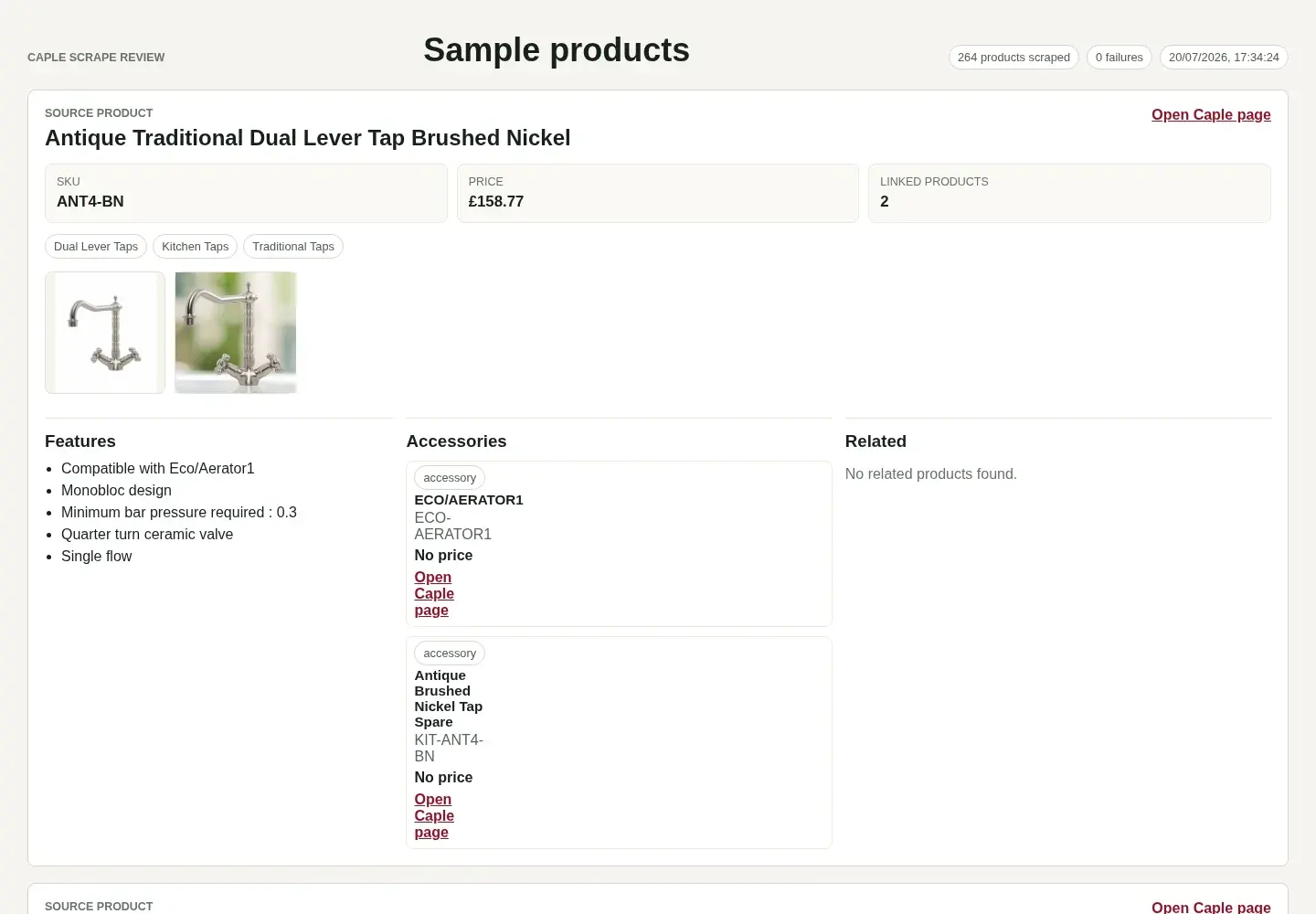
The architecture separates collection, judgement and delivery so each stage can be inspected and rerun independently.
Caple WooCommerce product and accessory pages.
Reliable selectors expose SKU, price, gallery images, features, accessories and related items.→The scraper normalises the source into one catalogue shape.
scrapeCapleSample.mjs uses shared validation before anything moves into the later stages.→caple-sample-products.json becomes the canonical snapshot.
Every later step consumes the same reviewed snapshot instead of scraping the supplier again.→The Next.js review route makes errors visible.
Products, prices, images, features and product relationships can be checked together before import.→Images are converted to WebP and data is mapped relationally.
R2 holds web media; Supabase stores products, images, specifications and ordered product links.→Exact verification gates the production website.
The verifier checks rows and ordering; product pages then read the catalogue through Supabase RPCs.Responsible only for reading and normalising supplier content.
Keeps automation and publication deliberately separate.
Moves approved assets and relationships into production-ready storage.
A scraper can be syntactically correct while still misunderstanding a product. The visual review surface catches those semantic errors.
Image processing, importing and verification share the same JSON contract, avoiding different stages seeing different supplier data.
The pipeline can be safely rerun, but independent verification and small batches remain the safety net because the workflow is not one large transaction.
MORE WORK